

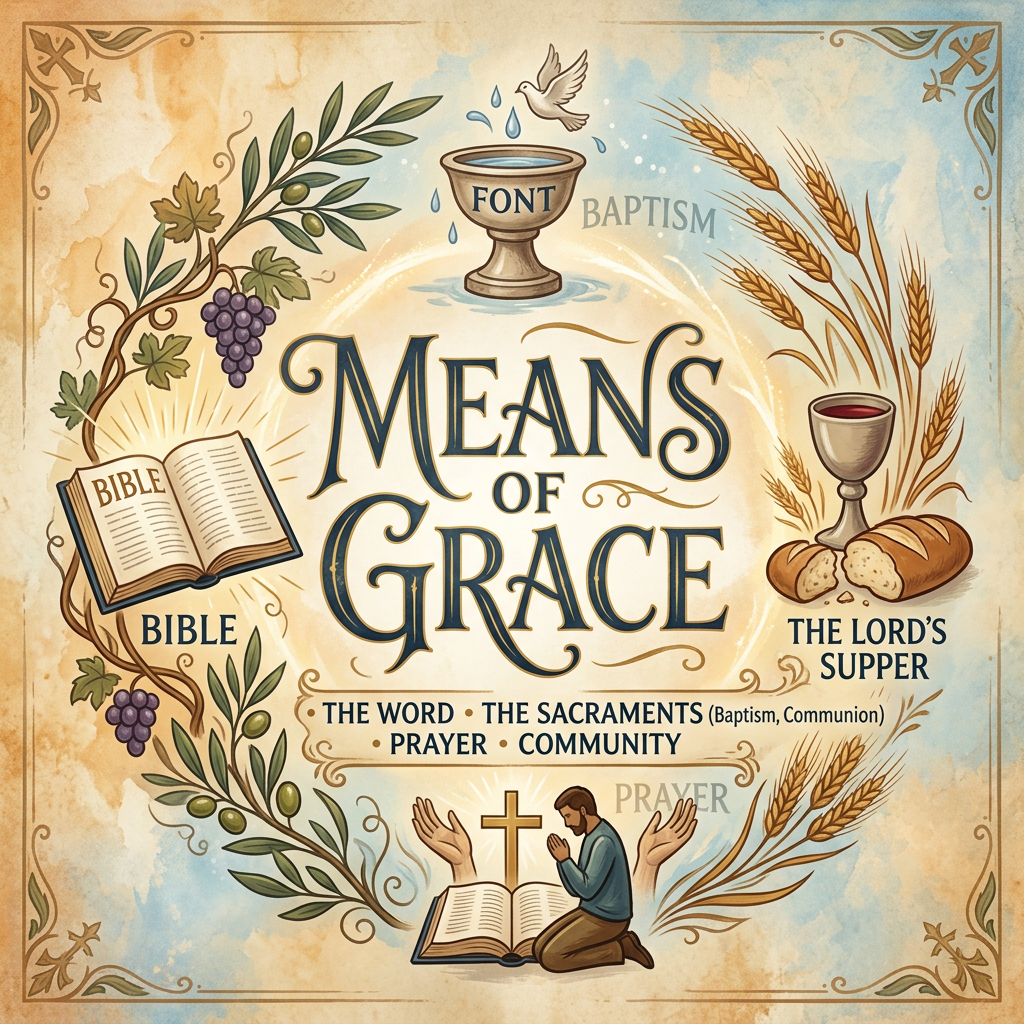
Wesley did not trust feelings. He trusted disciplines. And he believed God used both — but insisted on the latter when the former went missing.
Modern spirituality loves the spontaneous. We want encounters, breakthroughs, mountaintop experiences — the burning-bush variety of religion. Wesley, who had a perfectly good burning-bush moment at Aldersgate in 1738, spent the rest of his life insisting that most of the Christian life happens nowhere near a burning bush. It happens at the table, at the font, on the knees, in the gathered community, in the open Bible.
He called these the means of grace: instituted practices — prayer, Scripture, the Lord’s Supper, fasting, Christian conference — through which God has promised to meet us. Not that grace is trapped in the ritual, as if the wafer had magical properties or the prayer formula unlocked a cosmic vending machine. Rather, God, who is entirely free, has graciously committed to show up when his people show up — faithfully, expectantly, and with open hands.
“Wait on God in the way of His ordinances,” Wesley wrote — not because the ordinances are God, but because God meets us where he told us to look.”
This is a desperately needed corrective for a church that has confused entertainment with encounter. We do not command God to appear by our creativity or our production values. We make ourselves available — consistently, even when it is dry, even when the feeling is absent — trusting that the God who once met Jacob in a ditch and Elijah under a juniper tree is perfectly capable of meeting us in a Wednesday prayer service in a half-empty room.
Wesley received Communion as often as he possibly could — sometimes daily. He did not wait for the mood to strike. He showed up because Jesus said, Do this — and Wesley took Jesus at his word. That kind of unglamorous fidelity, practiced across a lifetime, is what Wesleyan spirituality actually looks like from the inside. It is less a flame and more a furnace: steady, hot, reliable — and fueled by very ordinary wood.